How to Test CAT6 Cable Length & Why It Matters for Networks
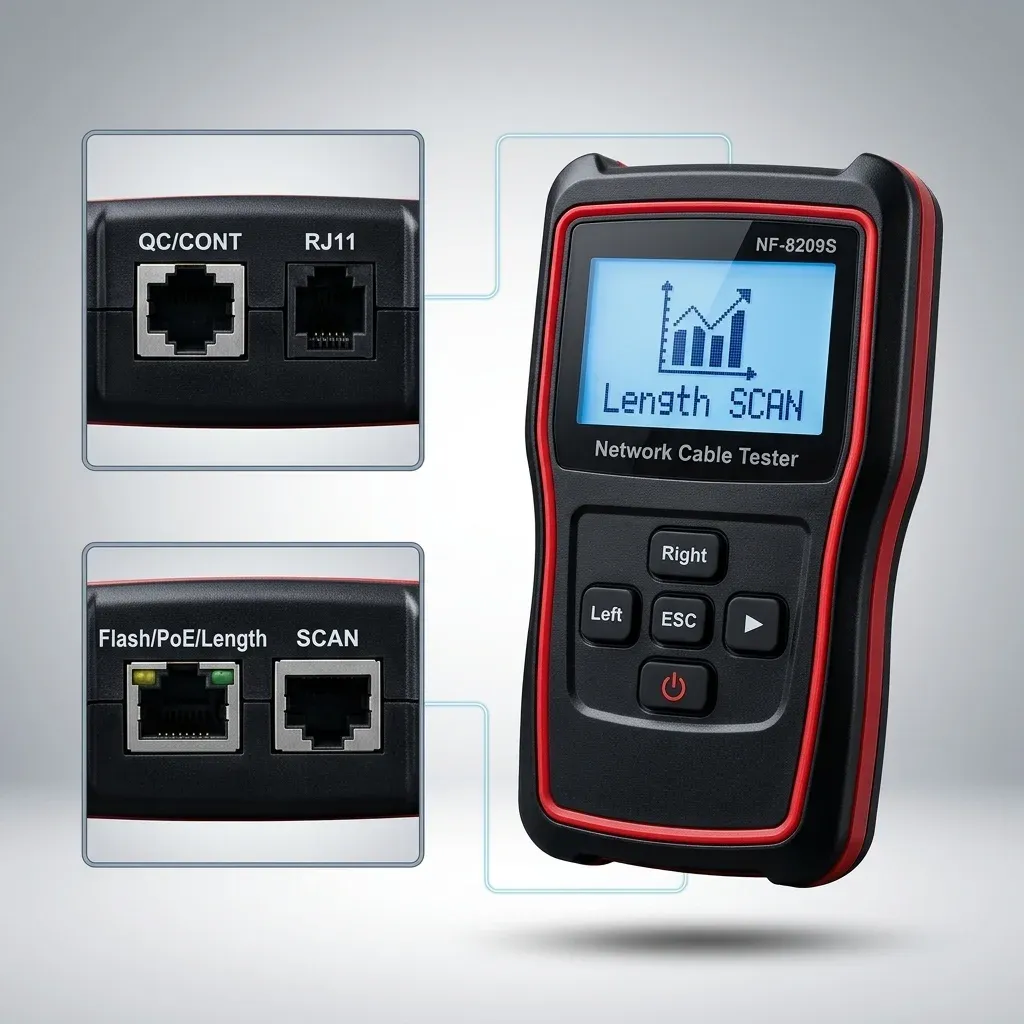
To test CAT6 cable length, use a network cable tester with Time Domain Reflectometry (TDR). It sends a pulse through the cable, measures the reflection, and calculates the run length using the cable’s NVP setting. In practice, this is the most reliable way to check whether a CAT6 run stays within the standard 90-metre permanent link or 100-metre channel limit, and whether it is suitable for 1Gbps or 10Gbps use.
TL;DR: If you want to know how to test CAT6 cable length, use a CAT6-capable tester with TDR, set the correct NVP for the cable, and compare the result against recognised limits: 90m for a permanent link, 100m for a full channel, and around 55m for 10Gbps on standard CAT6. Based on our testing in UK installations, length checks are one of the quickest ways to spot slow links, PoE voltage drop issues, and out-of-spec cabling before they cause faults.
What is the best way to test CAT6 cable length?
The best way to test CAT6 cable length is with a dedicated Ethernet cable tester that includes Time Domain Reflectometry (TDR). Unlike a basic continuity tester, a TDR-based unit does more than confirm that the pairs are connected. Instead, it measures how far a signal travels along the cable and then calculates the physical length.
When we test CAT6 runs in offices, schools and healthcare environments, we do not rely on guesswork or patch lead estimates. Rather, we use testers that provide an actual distance reading for each pair. This helps confirm whether a run meets specification and whether extra investigation is needed.
In simple terms, TDR works like an echo test. The tester sends an electrical pulse down the cable and listens for reflections caused by the end of the cable or by faults. It then uses that timing information to estimate the total length.
Can a cable tester measure CAT6 cable length accurately?
Yes, a good cable tester can measure CAT6 cable length accurately, provided it supports TDR and has the correct Nominal Velocity of Propagation (NVP) setting for the specific cable. However, accuracy depends on both the quality of the tester and how well it matches the cable construction.
NVP describes how fast an electrical signal travels through that particular cable compared with the speed of light. For CAT6, this often falls around 68% to 70%, although it can vary by manufacturer. Therefore, if the NVP is wrong, the reported length can also be wrong.
Based on our testing across common UK solid copper CAT6 installations, testers with adjustable or pre-set NVP values consistently produce more dependable results than low-cost wiremap-only units. So, if accurate distance matters, especially for longer runs or PoE devices, this feature is essential.
Why does NVP matter when measuring CAT6 length?
NVP matters because the tester converts signal travel time into metres. If it assumes signals move faster or slower than they really do in your cable, your reading will be inaccurate. Consequently, installers may think a run is compliant when it is actually too long.
How do you test CAT6 cable length step by step?
If you want a practical method for how to test CAT6 cable length, follow these steps:
- Disconnect both ends of the run from live equipment where possible.
- Connect your TDR-capable tester to one end of the CAT6 link.
- Select the correct cable type or NVP value for that specific CAT6 cable.
- Run a length test. Many testers will show overall length as well as pair-by-pair distance.
- Check for consistency across pairs. Large differences may indicate damage, poor termination or split pairs.
- Compare results with standards: 90m permanent link or 100m channel for general Ethernet use.
- If using 10Gbps on standard CAT6, confirm that runs stay within about 55m.
After that, if results are close to or beyond limits, inspect patch leads, route changes and cabinet slack before assuming there is a fault in active equipment.
What is the maximum CAT6 cable length?
The recognised maximum CAT6 channel length is 100 metres. This usually consists of:
- 90 metres permanent link between patch panel and outlet
- Up to 10 metres total patch leads across both ends
According to UK-aligned structured cabling guidance such as BS EN 50173, this limit exists to maintain signal quality and predictable performance. In other words, exceeding it increases attenuation and raises the chance of unreliable links.
How long can CAT6 run at 1Gbps?
CAT6 can support 1Gbps up to 100 metres, assuming compliant installation practices and acceptable test results.
How long can CAT6 run at 10Gbps?
Standard CAT6 is typically rated for 10Gbps up to around 55 metres. Beyond that point, performance may drop off sharply and devices may negotiate down to lower speeds instead.
Why does CAT6 cable length matter for performance?
Cable length matters because longer runs increase attenuation, which means signal strength drops as distance increases. As a result, even if a connection appears to work initially, it may suffer from poor stability, lower speeds or intermittent errors under load.
Moreover, longer lengths can affect PoE performance because resistance increases with distance. That causes voltage drop along the run. For devices such as IP cameras, wireless access points and VoIP phones, this can lead to startup issues or unreliable operation.
Based on our testing of PoE-powered devices in UK commercial networks, excessive run length is one of the most common hidden causes of unexplained power problems. Therefore, checking distance early often saves time during fault-finding.
Can you test CAT6 cable length without a professional tester?
You can estimate it manually if you know the route taken through containment or trunking; however, you cannot verify true electrical length reliably without a proper tester. A tape measure may tell you roughly how long a visible section is, but it will not account for slack loops, routing changes or installation irregularities behind walls and ceilings.
A simple continuity tester also will not tell you accurate run length. It only confirms whether conductors are connected in roughly the right order. So although it has some value for basic checks, it does not properly answer the question of how to test CAT6 cable length.
Is a CAT6 tester different from a basic Ethernet tester?
Yes. A proper CAT6 tester is different from a basic Ethernet tester because it needs better measurement capability and tighter tolerances. While an entry-level unit may confirm wiremap only, a more capable tool will also measure:
- Cable length via TDR
- NVP-adjusted distance
- Error conditions such as opens or shorts with approximate fault distance
- In some cases, PoE presence and voltage details
This matters because CAT6 operates at higher frequencies than older cabling types and must meet stricter performance expectations. Therefore, using an unsuitable tester can lead to misleading results.
What should you do if your CAT6 run is too long?
If your measured run exceeds specification:
- Shorten the route, if possible
- Move cabinets or endpoints closer together
- Add an intermediate active device, such as a switch in an appropriate location
- Consider fibre uplinks for longer backbone distances
- If aiming for 10Gbps, consider moving from CAT6 to CAT6a where required
Naturally, simply leaving an overlength run in place may appear cheaper in the short term; however, it usually creates future troubleshooting costs and inconsistent user experience.
How do you know if CAT6 length is causing slow speed or PoE issues?
You should suspect excessive length if:
- A link only negotiates at 100Mbps or 1Gbps when higher speed was expected
- A device connects intermittently after being moved further away
- A PoE device powers up inconsistently or reboots under load
- A certified-looking installation still fails real-world performance checks
In these cases, measuring actual cable length is one of the first sensible tests. After all, if the physical layer is out of spec, no amount of switch configuration will fix it properly.
Frequently asked questions about how to test CAT6 cable length
Can I use any network tester to measure CAT6 cable length?
No. You need a tester with TDR-based measurement. Basic continuity testers do not provide dependable distance readings.
What is considered too long for a CAT6 cable?
A full channel above 100 metres is too long under normal standards-based design. For standard CAT6 at 10Gbps, anything over about 55 metres may also be problematic.
Does every pair need to show roughly the same measured length?
Ready to speed up your diagnostics with EthernetCA?
Upgrade Your Toolkit — £114.14